Mass Production and the Democratization of the Automobile. Henry Ford’s Revolution 1900–1929
- Robert Merle
- Jul 17
- 7 min read


Introduction:
At the turn of the century, the United States was beginning to emerge as an industrial superpower. Immigration, industrialization, technological advancements, vast reserves of natural resources, and capital allowed the country to reach new heights. The nation reached westward and was connected by a vast network of railroads and a slowly growing road system. The automobile had been developed in the late 1800’s and had gone through many different variations, improvements, and prototypes in the early decades of its development. Henry Ford, the founder of the Ford Motor Company, would create a lasting impact on not just the automobile industry but also on mass production and affordability for the average American household.
Ford was not the first inventor of the automobile, nor were his early models deemed the finest on the roads. What made the famous “Model T” the most purchased vehicle in the country for years was its ability to be produced quickly and efficiently, and also its starting price point. The Model T was introduced in 1908, with the goal of "a motor car for the great multitude." The sheer scale and production of this car and the success of the Ford Motor Company were profound on American society. “The famous “Model T,” in September 1908. By the time the last Model T rolled off the assembly line in May 1927, a phenomenal 15 million of them had been sold. In 1918, a farmer’s wife near Rome, Georgia, wrote to Ford: “You know, Henry, your car lifted us out of the mud; it brought joy into our lives. We loved every rattle in its bones. . . .”.

To evaluate the major changes Ford had in this era, one can look at the statistics and company reports and the personal and contemporary accounts from the era. To understand the growth and changes Ford made in the industry, one first needs to look at the price and size of production of its vehicles. At the time of opening his Highland Park plant in Michigan, it took close to 13 man-hours to assemble one single automobile in a factory. Revolutionizing the use of the assembly line, production of a new automobile could be achieved in as little as 93 minutes. Between 1909 and 1917, the price of the Model T lowered year to year from $950, $780, $690, $600, $490, $440, $360. While continuing to cut the price, Ford production grew from 18,664, 34,528, 168,220, 248,307, 308,213, 533,921, 785,432. These staggering figures helped raise the Ford Motor Company’s worth to over 1.2 billion during the 1920’s.
Achieving such groundbreaking production and sales numbers, Ford fundamentally changed the methods of production within his factories that would serve as the blueprint for all facets of American industry and manufacturing. Ford's announcement of the 5-dollar workday was a groundbreaking moment for labor in the United States and earned attention around the world upon its release in 1914. Before this announcement, at some of the Ford company factories, it was seeing labor turnover rates over 370%. “If the need to retain workers was a partial motivation for the Five-Dollar Day, then the solution may have worked too well. Within days of the announcement, thousands of applicants came to Detroit from all over the Midwest and entrenched themselves at Ford’s gate. The company was overwhelmed, riots broke out, and the crowds were turned away with fire hoses in the icy January weather. Ford announced that it would only hire workers who had lived in Detroit for at least six months, and the situation slowly came under control.”
With the rapid increase in applications to work for Ford, new workers had to undergo a system of background checks and procedures before securing the position. In order for workers to qualify for the new salary, they had to meet certain moral and ethical standards. Workers were required to drink alcohol, keep their dwellings and living conditions clean, put money in a savings account, and abstain from crime or physical violence. Workers faced background checks from the Sociological Department and would root out employees who did not meet these moral requirements. Eventually, the department was disbanded due to workers being upset over the intrusion into their lives and actions, but its implementation created a serious debate over the limits that an employer can have over regulating the personal actions of its employees.
Ford’s moral and personal convictions for his workers can be seen in his Autobiography My Life and Work in 1922, he writes,
“There is no reason why a man who is willing to work should not be able to work and to receive the full value of his work. There is equally no reason why a man who can but will not work should not receive the full value of his services to the community. He should most certainly be permitted to take away from the community an equivalent of what he contributes to it. If he contributes nothing, he should take away nothing. He should have the freedom of starvation. We are not getting anywhere when we insist that every man ought to have more than he deserves to have--just because some do get more than they deserve to have.”
Ford, beyond his business practices and company, looked to promote social change based on his own beliefs. He was an openly and widely known anti-semite who openly rooted out Jewish employees from his company, and his views against Jewish people became so well-known in the United States and abroad that he is the only American whom Adolf Hitler mentions by name in Mein Kampf.

The major shift in his factory structure that had a profound impact was the changes to the assembly line. Before this, industrial factories used a mix of different procedures and tools to complete its production. In the late 1800’s, companies and factories began to use more interchangeable parts to further increase efficiency and streamline installing and repairing damaged apparatus. As simplicity and efficiency became the main methods for increased output, Ford’s changes took it a step further. Before the changes made at Ford plants, workers were tasked with going to the automobile and completing various tasks. A crew of several workers would complete different tasks of its assembly from the beginning of its production to final completion. Ford flipped the script and had the automobile go to the worker. Placing workers at assigned different stations and refining tasks to a simpler and more specific role, car production time was cut drastically. Furthermore, it looked to build on the idea that a non-skilled worker or a worker of limited intelligence and ability could be developed to complete tasks efficiently. Below is a video that details this process,
In 1925, the Ford Motor Company received a call from Britannica, asking if it would be willing to share how it improved its methods of efficiency in its factories. Ford himself took up the request as he was eager to discuss and share his advances. His response was, “What are those production methods in use today in every large automobile plant with scarcely any variation? They are simply the methods of Eli Whitney and Samuel Colt, improved, coordinated, and applied with intelligent economy, economy in time, space, men, motion, money, and material”.

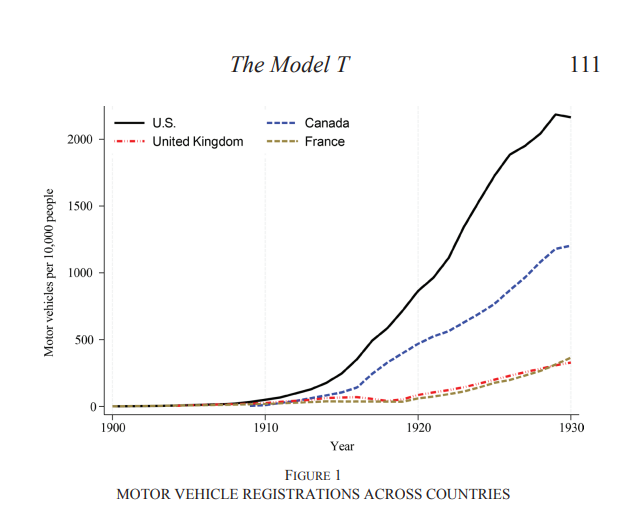
The effect of the assembly line saw the affordability of the Model T change drastically for consumers. Prior cost trends were mentioned earlier, and the fact that in 1908 the average cost for a new Model T automobile was $825 to by 1925 the average cost was around $260. This changed the idea of a family owning an automobile from a luxury to a readily accepted commodity. The Model T’s production numbers were truly staggering; in its lifetime, it had over 15 million produced and held records as the best selling automobile for nearly 50 years.
The impact of this affordability on American consumers was remarkable. A ripple of widespread changes caused long-term ramifications for the nation's structure and society. Americans could now commute farther to work, life in newer emerging towns and suburban areas. With new towns and cities being able to change it would create a massive increase in the need for more roads, auto shops, gas stations, and the American tourism and travel industry. The ripple effects of automobile affordability are difficult to quantify over the early 1900’s.
Conclusion
What are some of the lasting impacts that Henry Ford had on American industry? The revolution of mass production helped lead to a revolution in affordability within the automobile industry. His business model focused on the belief of high production meant lower prices, lower costs, more customers, more sales, and in turn larger profits. This belief has been carried into many different fields of the American and global economy. By making automobiles affordable to ordinary Americans, he transformed transportation, stimulated numerous related industries, and established mass production as the dominant model of twentieth-century manufacturing.
Bibliography
Constant, E. W. Review of From the American System to Mass Production, 1800–1932: The Development of Manufacturing Technology in the United States, by David A. Hounshell. Journal of Social History 21, no. 4 (1988): 793–95. http://www.jstor.org/stable/3788015.
Eli, Shari, Joshua K. Hausman, and Paul W. Rhode. "The Model T." The Journal of Economic History 85, no. 1 (2025): 110–151. https://doi.org/10.1017/S0022050725000014.
Ford, Henry. My Life and Work. Garden City, NY: Doubleday, Page & Company, 1922.
Ford, Henry. Today and Tomorrow. Garden City, NY: Doubleday, Page & Company, 1926.
Ford Motor Company. Advertisements. Library of Congress. Accessed July 17, 2026.
Ford Motor Company. Advertisements. The Henry Ford Digital Collections. Accessed July 17, 2026.
Garden of Praise. "Henry Ford." Accessed July 17, 2026. https://gardenofpraise.com/ford13.htm.
History.com Editors. "Henry Ford's Dark Side: Anti-Semitism and Worker Treatment." History. Accessed July 17, 2026. https://www.history.com/articles/henry-ford-antisemitism-worker-treatment.
Hounshell, David A. From the American System to Mass Production, 1800–1932: The Development of Manufacturing Technology in the United States. Baltimore: Johns Hopkins University Press, 1984.
Nevins, Allan, and Frank Ernest Hill. Ford: Expansion and Challenge, 1915–1933. New York: Charles Scribner's Sons, 1957.
Origins: Current Events in Historical Perspective. "Henry Ford and the Automobile Industry." Accessed July 17, 2026. https://origins.osu.edu/sites/default/files/migrated_files/origins-archive/Volume2Issue1Article12.pdf.
Watts, Steven. The People's Tycoon: Henry Ford and the American Century. New York: Alfred A. Knopf, 2005.
Bill of Rights Institute. "Henry Ford and Alfred P. Sloan: Industrialization and Competition." Accessed July 17, 2026. https://billofrightsinstitute.org/essays/henry-ford-and-alfred-p-sloan-industrialization-and-competition/.


Comments